Why the Automotive Industry Chooses Our Foams
Our high-performance automotive foam solutions combine lightweight construction with exceptional durability, resilience, and thermal performance. Designed to withstand demanding automotive environments, our specialist foams offer excellent compression strength and recovery, impact and energy absorption, thermal insulation, and resistance to heat, cold, chemicals, and solvents. Low-emission and low-fogging grades are also available, alongside conductive, static-dissipative, thermoformable, and OEM-approved materials.
Lightweighting
Noise, vibration, and harshness (NVH) reduction
Impact protection and safety
Aesthetic and structural use
Comfort and ergonomics
Thermal insulation
Sealing and water resistance
Purity and emissions standards
Chemical and solvent resistant
Automotive Foam Applications


Where are our materials often used?
Common applications of our automotive foam within a car

Tech Support
Our experienced Application Engineering team works closely with our customers in the automotive industry to optimise material selection, design, and processing. From concept to commercialisation, we provide tailored technical support to help you get the best performance from Zotefoams materials in your automotive application.

Frequently Asked Automotive Questions
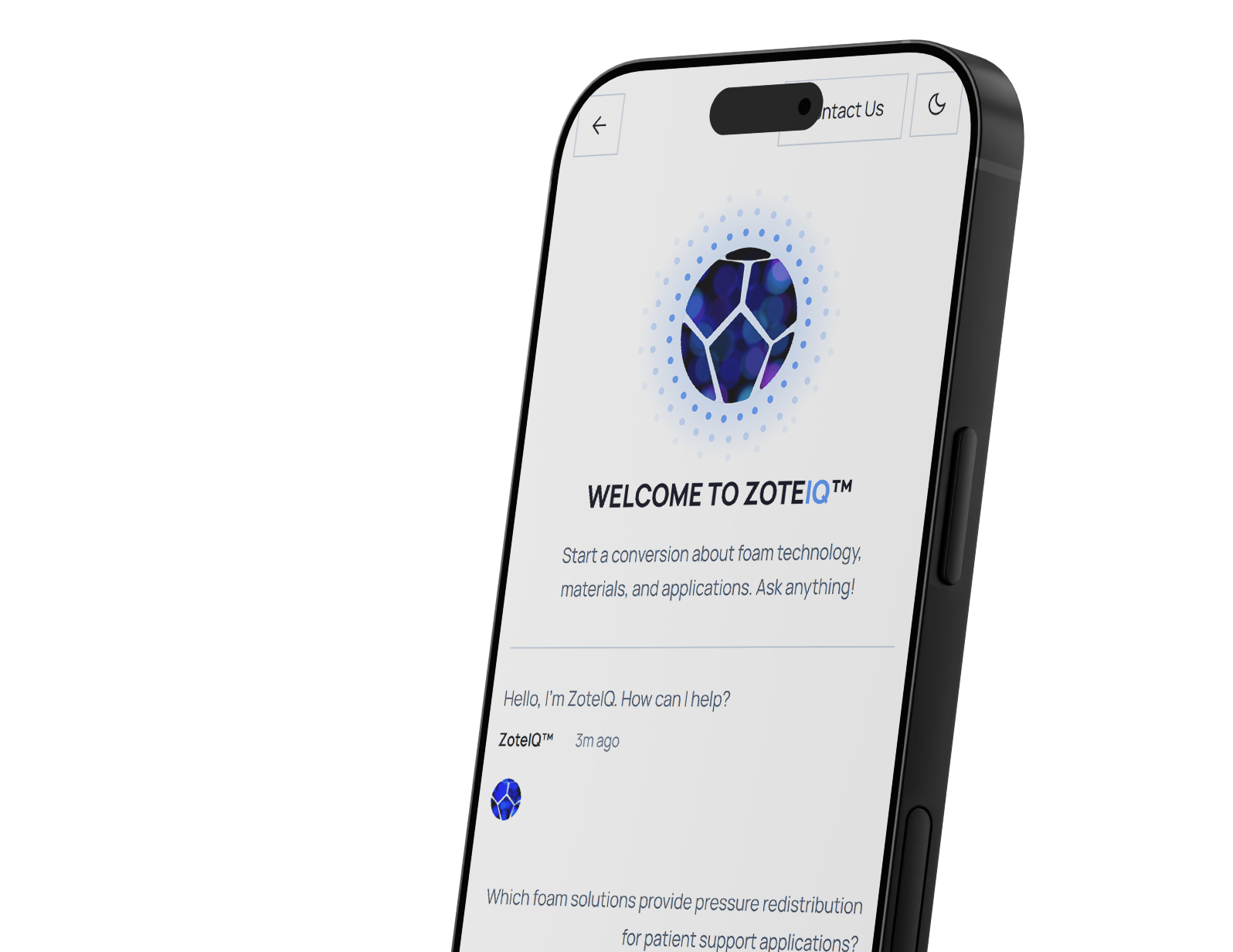
Ask ZoteIQ a QuestionZotefoams manufactures a range of closed-cell foams based on different polymer families, including polyolefin and high-performance fluoropolymer materials. The appropriate material depends on the application and required properties, such as temperature resistance, chemical resistance, cushioning, sealing, insulation or weight reduction
Material selection should consider the application, operating temperature, mechanical requirements, chemical exposure, emissions and fogging requirements, processing route and applicable OEM specifications. Zotefoams can support material selection, but final suitability should be confirmed through component-level testing and application-specific validation.
Yes. Zotefoams can work with customers to review application requirements, relevant material properties, processing needs and required test or documentation criteria. OEM requirements can vary by manufacturer, component and vehicle programme, so compliance should be confirmed against the exact material grade and applicable specification.
Yes. Selected Zotefoams materials can support applications in electric, hybrid and conventional vehicles, including sealing, thermal insulation, NVH management and other lightweight components. Material selection should consider the specific temperature, electrical, chemical, mechanical and safety requirements of the component.
Yes. Lightweight foams can replace or reduce the use of heavier materials in selected components where the required mechanical, thermal and environmental performance can still be achieved. The complete component should be designed and validated for its intended function rather than assessing weight reduction in isolation.
Yes. Product Information Sheets and Technical Information Sheets are available for relevant grades, covering properties such as density, mechanical performance, thermal behaviour, flammability and emissions testing. Additional test or compliance documentation is grade-specific and should be confirmed against the exact material, manufacturing site and customer requirement.
Yes. Involving Zotefoams early can help identify materials against the required mechanical, thermal, chemical, emissions and processing requirements before the component design is finalised. Candidate materials can then be assessed and validated against the requirements of the specific vehicle programme.
Zotefoams can support automotive applications from development and validation through to production. Material availability, format, processing route and volume requirements should be discussed for the specific programme to ensure an appropriate supply and conversion solution.
Explore Our Automotive Foams
For interior components, electronics protection, cushioning and sealing applications.
For thermal management, NHV reduction and engine bay applications.
For safety, impact management, EV battery applications.
Ready to Find Your Foam ™ ?